
New Orleans needs a hand, not a hero
- Izayah Morgan
- Mar 27
- 5 min read
By Izayah Morgan
Editorial Staff
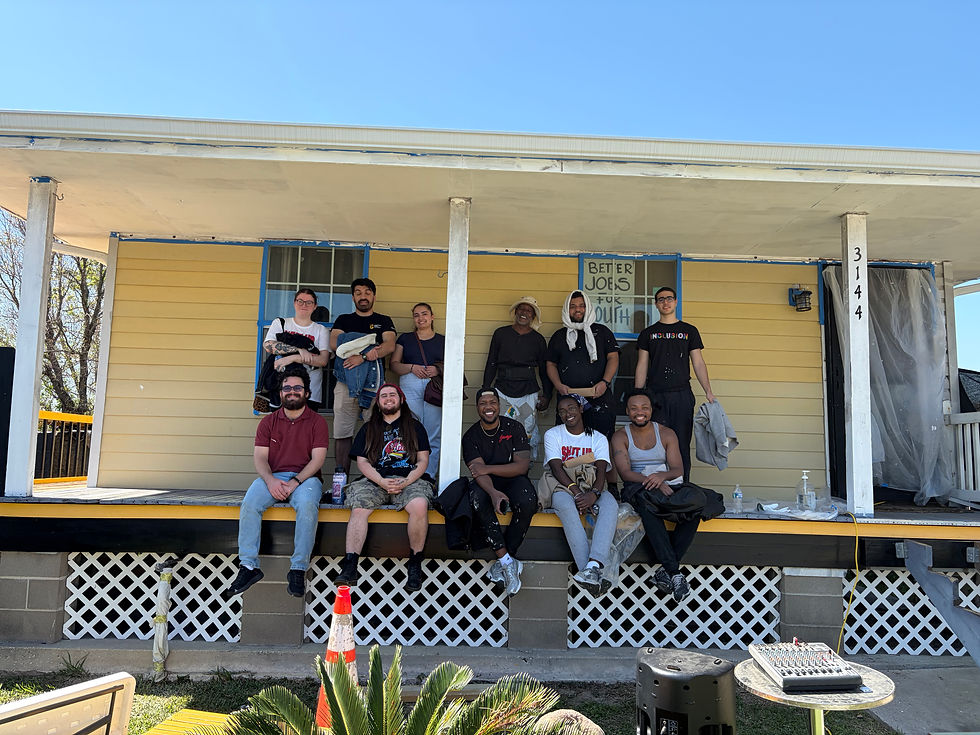
This spring break, I took the opportunity to travel with the CIE Director Jerome Burke and Program Coordinator Emma Laurie along with nine other students to New Orleans to volunteer for service work.
We worked in partnership with a local organization called HandsOn New Orleans. They are a non-profit organization of just three people: Executive Director Chris Cameron, Director of Operations Ellie Duff, and Assistant Director of Programs Kristin Hartlage.
Together, they are the glue that holds the organization together.
Their mission is to empower volunteers and create service projects to help build up the community. This looks different depending on where the service project is located. These can be projects relating to public schools, neighborhood development, gardening, disaster management, and youth recreation.
According to their website “HandsOn completes 60+ community service projects each year by recruiting 5,000+ volunteers to serve low income residents.”
For the three days of service we committed to, we ended up working on two different projects undertaking various activities such as moving stones, painting a roof and putting up fences in community gardens owned by local residents.
One of the gardens was owned by Gloria Ward. She was moving her garden out of her apartment complex to property she recently purchased where she also hopes to build a house. She’s moving to a space where she’ll have more freedom over her garden.
“Im too old to fight over a garden,” she said.
For Gloria, it is all about bringing the community together. She has people from all over the city come to visit her garden. As we were helping Gloria, a local band came over to practice playing before their show.
She has different activities in the garden for the community that could run until 10 o’clock at night. For example, every year, she has a big sock puppet show that’s free to everyone.
Her hope with a new garden is that she’ll be able to host more events for the community such as cooking or art classes with children.
With the group’s service work, we were able to move her one step closer to starting her new garden.
On the second and third day, we helped Karl Washington. He again was a local community member who bought a home years ago and has been repairing it since. His home was near completion, so our job was to build his fence and paint around the property.
He is an integral member of the community, as junior Eli Onyeabor pointed out, you could see the love the community had for him. As we were waiting for the bus to pick us up, Onyeabor pointed out how everyone passing would stop and wave at Karl.
One thing I learned from Karl and Gloria was that age is nothing but a number. Primarily working on Karl’s fence, along with me, was Burke, sophomore Ezra Mason, and Karl himself. Gloria was helping our group move heavy stones all day. Both still moved as if they were in their early 30s, guiding us and teaching us throughout the service.
As I spoke to Cameron, he wanted people to know that New Orleans still has work to complete. After Hurricane Katrina ravaged the neighborhoods, relief was hard to come by.
Before Cameron took on HandsOn New Orleans, it was on the verge of being shut down. He said, “All the Katrina money had been mismanaged.” He spent three months listening to community partners and volunteer leaders the organization said they had trained.
After a three-month listening tour, Cameron came back to the board of directors and said, “We’re keeping the name, you have nothing here, we’re not rising to the moment, and we’re going to change it.”
At that time, he had about $25,000 in the bank with a $100,000 grant on the way. Today, he has about $1.7 million in non-profit funds 14 years later.
Cameron said, “ Everyone has the power to be a change agent. It requires you to listen more than you ever speak in order to listen to hear their needs. You need to know how and why they got to this place, and what help they need.”
This is what makes a good volunteer - not someone looking to save a community, but someone who will listen to the community they are serving.
From what I learned, sometimes the best service is not even much service at all but listening. This can be a cultural shock to many first-time volunteers but nevertheless critical to being an ally to that community.
Burke’s goal was to develop the alternative spring break to center students and create an experience that produces meaningful learning opportunities that can go beyond the classroom.
He chose New Orleans because of the “rich cultural history” and because after Hurricane Katrina, it is still recovering. He wanted students to see how a disaster can have long-lasting effects on a community.
And it was so true. Karl shared some of that history with us. “It took about 15 years for us to get back to some sense of normalcy after Katrina.”
The service in Burke’s eyes, was amazing and allowed students to see the tangible effects they had on a community. No doubt it was hard work as I almost passed out a couple of times because of the heat, though HandsOn New Orleans had more than enough water, so that’s on me.
Senior Oscar Rubyck said his favorite part of the trip was exploring the city’s rich history and trying memorable food, his favorite being the Waffle Time restaurant.
Mason had a similar experience being able to “adventure through the French Quarter with our group and eating at Cafe Du Mondes, lounging in Jackson Square, and being able to look at all the artwork being sold and displayed.”
In Massachusetts, public transit can be hit or miss sometimes. CIE Program Coordinator Emma Laurie said, “Navigating public transport and delving into the local community” was one of the most memorable parts for her.
According to Burke, there are many ways to improve the trip moving forward, including “enhancing reflection sessions during and after the trip to deepen learning outcomes,” hosting information sessions, sharing student testimonials, and creating tangible campus activities to build interest.
Looking ahead, even though I will be graduating, I hope the CIE will be able to expand this trip to other areas and include more students. Burke said dream locations for this program include places like Ghana, Jamaica, and Germany. Each place has its own history, political systems, and culture to learn from.
Even though those are dream locations, Burke stressed, ”We will continue to partner with organizations across the U.S., serving one community at a time.”
All in all, that’s what it’s about: not saving a place, but offering your hand in service to help a community that needs it.
One hand at a time.


